Review: Talislanta Sixth Edition
I am a long-time admirer of Talislanta, though I've never yet run it or played it. We'll discuss some of the reasons for that later; for now, understand that I was quite excited and somewhat trepidatious when Everything Epic (a company I've never heard of) announced a new edition, the sixth, on one crowdfunder or another a couple of years ago. It took some research and soul-searching for me to decide to back the thing at all. See, I own every first-party book from the first and second editions, as well as the big blue fourth-edition book, and again, I haven't yet played the thing. I'd already decided by this point that the third and fifth editions didn't have anything I'm interested in (above and beyond what I already have in the other editions), so I wasn't optimistic that this new edition would be much different.

A Half-Remembered History of Talislanta
To explain why, let's talk a moment about the publication history of Talislanta—I swear it's relevant. The first edition came out in 1987, the same year I was born. An auspicious year. Through the lens of the last thirty-nine years of role-playing books, that edition looks prescient in many ways: it prefigured the partial success of Apocalypse World, the character backgrounds of Troika, the "rules-lite" tendency of role-playing from the 2000s to today, and the loud (but only half-in) rejection of "vanilla" fantasy that has come to define settings not published by TSR or Wizards of the Coast. Indeed, the "No elves" mantra was always marketing language extraordinaire—technically true, but practically meaningless. You can call your lithe, pointy-eared, aristocratic magic-users whatever you want, they're still kind of elves.
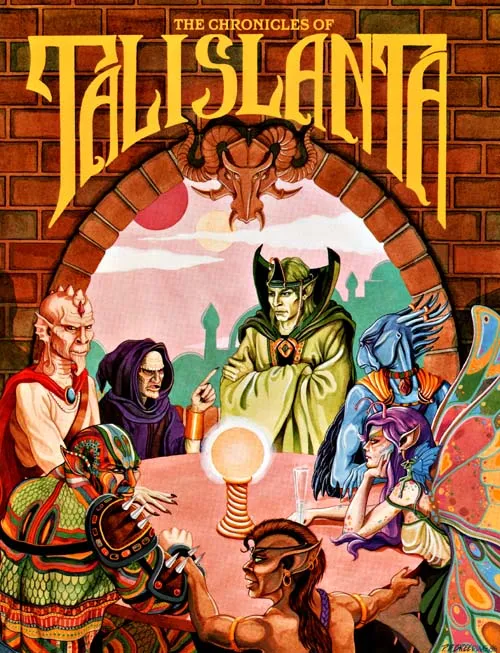
This first edition included The Talislanta Handbook, a core-rules equivalent, presented in a truly odd way. After eight pages of rules, the remainder of the book is comprised of various appendices: character backgrounds, skills explanations, spells, equipment, and a gamemaster's section. From there the 1e line included a bestiary titled A Naturalist's Guide to Talislanta, a lore-heavy book of spells and spellbooks and other magical things titled Talislanta Sorcerer's Guide, and a setting book titled The Chronicles of Talislanta. This last is the real star of the show, and the reason why anyone (now or then) would be interested in Talislanta at all.
Chronicles is, in my estimation, unlike any other role-playing book. This isn't obvious just looking at it: it appears at first to just be a book full of lore, like any similar setting book. But the specific quality of the lore, the way that it is, is unique. The prose floats on the surface of things, nearly always in broad strokes and overview—an approach I don't generally find compelling, but it works here not least because the setting is so insistently idiosyncratic. A mountain range, the "Jade Mountains," one can only assume are huge chunks of actual jade jutting improbably, jaggedly out of the earth. The "Shadow Realm" is a hell-place, but one that sits unassumingly among other regions right there in the northern part of the continent. Everything here is so thoroughly filled with ideas that the whole could never have sustained a detailed analysis and explanation of each. It's a book of wonders presented plainly. It's a book of overlapping tropes that somehow feel lived-in and effortless. There's little I can do here to get the effect of this book across to you, you'll just have to read it. I don't suspect you'll regret it.
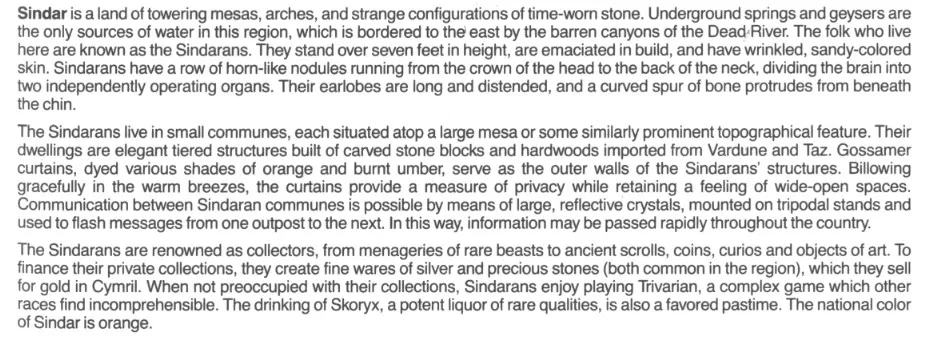
With the second edition of 1989, we get a newly typeset version of the The Talislanta Handbook, as well as a number of expansions upon the work started by The Chronicles of Talislanta. Most directly so, The Cyclopedia Talislanta simply adds more lore to the already lore-laden continent. From there, a series of region-specific Cyclopedias, as well as a Talislanta Worldbook that lightly enumerates a number of other continents on the same world (Archaeus) that holds the continent of Talislanta. The Cyclopedias themselves, being more limited in scope than Chronicles, find space to add some small granularity to the regions, though thankfully the prose remains light and airy throughout. These first and second editions are easily construed together, as functionally one edition with an updated rulebook thrown in shortly after the first presumably went out of print.
Starting with the third edition in 1992, Stephen Michael Sechi (Talislanta's creator and original publisher) decided to license the property to other companies. This edition went, perhaps predictably, to Wizards of the Coast. They had Jonathan Tweet go through the core rules and lightly fix it up to whatever passed for house standards at the time, and they did similar work to the other main books of first and second edition. Most remarkably, and most disappointingly, they included a line of adventure books (something conspicuously absent from Talislanta up to this point), all of which were basically very bad in precisely the ways that all adventure books were at the time. They even included a meta-plot, courtesy of Robin Laws, involving an uprising of "sub-men" across the continent. Overall, third edition is not remarkably different from the earlier editions except in polish and presentation (and in sheer number of words).
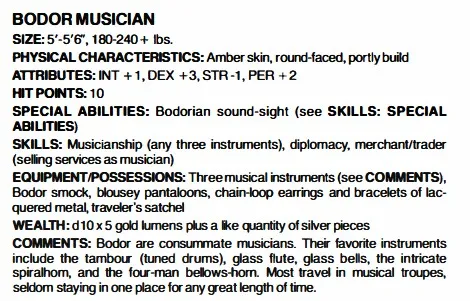
The fourth edition (2001), from Shooting Iron, is quite different from earlier editions in a number of ways. It represents a complete overhaul of the system into a form more legible to the trad and "indie" games of the early 2000s. Tellingly, John Harper was intimately involved in the creation of the book. Fourth edition also made the bold move of integrating all the various core material one would expect from an edition of Talislanta into one big book. Setting material, archetypes, bestiary entries, and spells all exist alongside each other. On first glance, this seems like a great idea, arranging all these elements by region (a weakness of every other edition of Talislanta, which make it needlessly difficult to collate the various content into the actual places in the setting where they're relevant), but in practice all the elements suffer. There simply isn't enough room in one big book to hold the copia required to communicate a Talislanta. The archetypes in the core rules have been severely stripped back from the hundreds in previous books, and the setting content is massively compressed into an overly broad gloss—a risk taken by all previous Talislanta lore, but a failure for the first time here. The bestiary and magic supplements help somewhat in this regard, but do little as innovative as the big book does.
The bestiary, called the Talislanta Menagerie for this edition, goes back to the supremely unhelpful ordering of entries alphabetically common to all previous editions—doubly unhelpful considering that basically all enemies in Talislanta have silly nonsense names. The magic book, hilariously titled Codex Magicus, is perhaps the worst magic book in the entire history of Talislanta publishing. It opens with some twenty-three pages of lore, then spends the remainder of the book realizing that the semi-improvisational magic system in the fourth edition doesn't leave a lot of room for writing actual spells or magical effects. So it has a lot of writing about specific ancient wizards (which is cool, but not directly gameable), with their associated spellbooks (which don't do much, because of how the magic system is in this edition), and often some related magic items (which are generally pretty good). All of this to varying degrees of success. It does add some new magical orders to the game, which is fun enough. Anyway, the fourth edition of Talislanta is the tightest mechanically of all of them, and will probably appeal if your table runs a bit more trad than mine does.
One thing that fourth edition does that, in my opinion, is a huge and necessary improvement over the older editions, is in how it handles combat skills and character advancement. Without getting too in the weeds (you can read the books yourself, they're free), the first and second editions gave characters a broad combat skill, either "Primary Combat," "Secondary Combat," or "Combat Training." These were Good, Middling, and Basic, respectively. These applied whenever that character did combat, regardless. And each of them progressed differently with level, where Primary Combat goes up by one every level, Secondary every two levels, and Training every four. This being an exception to the fact that all of your other skills go up by one every level. Fourth edition got rid of all those combat skills, and level-based progression entirely, and assigned character archetypes weapon-specific (or style-specific, in some cases) skills for combat. So your PC might have "Spear +2" as a skill to start with. To improve individual skills, you spend your experience points directly, no levels to be found. This is good, and is the one thing that makes fourth edition better than the older editions. To be clear: the way the older editions did it is basically fine, totally workable, and not so clunky as to be distracting. But the fourth-edition way is just much better, in my very opinion.
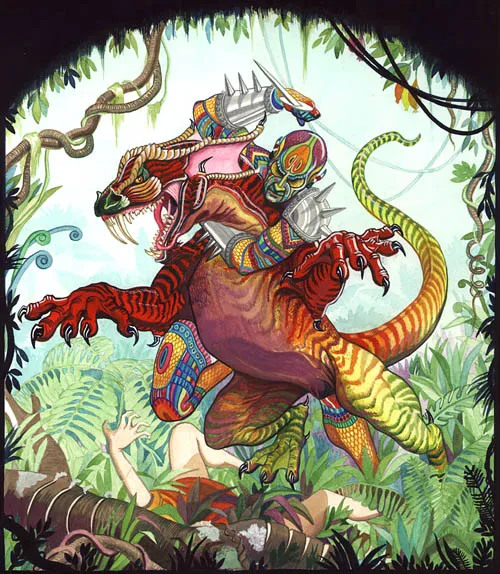
As for the fifth edition of 2007, in all honesty I haven't looked at it closely. A quick inspection revealed that it has life-path character creation, which doesn't align with what I love about or want out of Talislanta. The supplemental material seems at least as sparse and as questionable as that of fourth edition. Overall, the impression I have is that this is another step along the very trad path that Talislanta has been flirting with since third edition. Not my bag. Maybe it's good! As I said, I haven't looked at it much at all. Do report back if you check it out. Again, they're free to download.
Finally, Sixth Edition
And so the sixth edition.
The lede I've buried here is that, after more than twenty years of licensing the property to other companies, Stephen Michael Sechi has decided to make a new—and, if the ad copy is to be believed, a "final"—edition of Talislanta. To do so, he partnered with a company called Everything Epic, who seem mostly to publish board games I haven't heard of and don't care about. They used Gamefound to finance the print run, and seem to have done numbers significantly worse than typical for the company. Some large portion of that discrepancy is down to the market difference in role-playing books versus board games, I'm sure. The release included a huge separate volume for conversion to fifth-edition Dungeons and Dragons, which I won't be talking about any further. The other three books in the release are just a normal sixth edition of Talislanta, mercifully with no reference to any other game systems.
The first thing I want to acknowledge about sixth edition is the fact that P. D. Breeding-Black's art is nearly completely absent. Breeding-Black died in 2023, to my understanding, so that's surely understandable. More broadly, bringing in more and more new artists is a trend over editions starting with the third, but here in sixth edition, the art is fully... well, you tell me. Compare this to the rest of the art in this post (which is all from Breeding-Black):
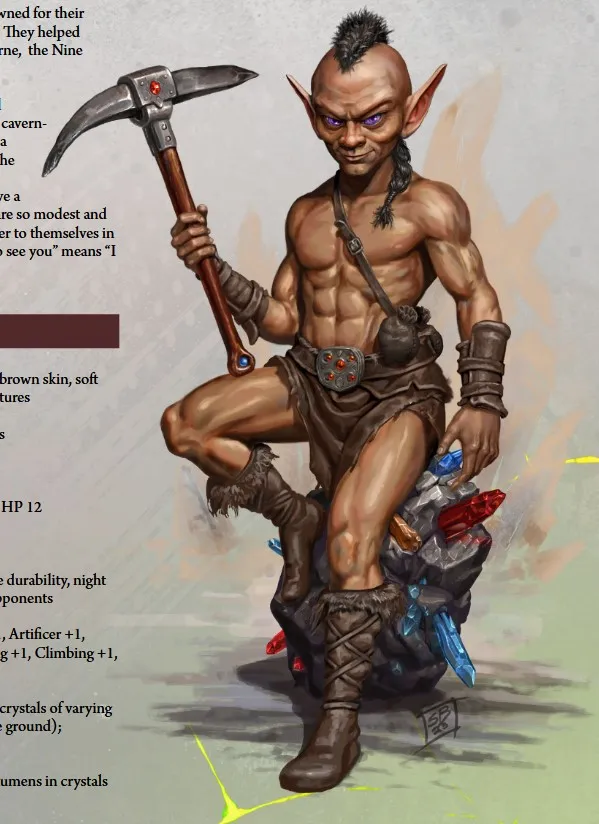
I won't comment further on the art or graphic design except to say it's very much not my style, but also I don't really care all that much. The sixth edition release comprises three books: Talislanta Player's Guide, Talislanta Bestiary, and Talislanta Atlas and GM's Guide. Let's take them one at a time.
The Player's Guide serves as the core rules, and to my eyes the systemic decisions made here are a slam dunk. It reads like a modernized, thoughtful version of the original rules, with some of the best ideas from the fourth edition worked in as well. So levels and Primary/Secondary Combat skills are out, "Spear +2" is in, and every skill gets its own independent starting value. Advancement is a matter of spending experience points directly to increase specific skills and attributes. Simple, great.
The magic system especially is a very deft combination of old and new. In the old games, magic felt very uniform: everyone with magic skill started with the same (very generous) spellbook, and they would have to find more spells out in the world. This is functional, but feels misaligned with the highly specific and regional nature of Talislanta as a setting. In the fourth edition, magic has Orders and Modes, and every spell is a combination of the two—and each is its own skill. So I might have Invocation (Heal) at a +3, and when I use Invocation magic to accomplish something related to Healing, I can use my +3 modifier. It's a bit fussy, to be honest, but I understand the benefits—miracles in Whitehack have a certain resemblance to magic in fourth edition Talislanta. Sixth edition keeps the idea of Orders, splitting magic into eleven schools, but takes the rest from first edition: each Order is its own skill, with its own list of beginning spells, and if you want more spells (or knowledge of more Orders), you should go find someone to teach you or something. For my money, this is exactly right for Talislanta.
The Bestiary is exactly as unfortunate as every other Talislanta bestiary. It's a book with a bunch of monster write-ups, arranged alphabetically, with no index to reference them by region or location. So if my players are tooling about in the kingdom of Carantheum, and I want to know what kind of stuff they might encounter, my only real option is to flip through the entirety of the bestiary and scan each entry for location, making a note of any that could serve. All it takes is a table, folks. A list, even. Anything. It wouldn't even be hard to put one together myself and just tuck it in the back cover of the book, but I really shouldn't have to. Otherwise, it's a perfectly serviceable bestiary, functionally identical to the bestiaries of previous editions.
Now the important one, the Atlas and GM's Guide. This book has huge shoes to fill, with how remarkable the old Chronicles of Talislanta book was and remains even now. But there are plenty of ways Chronicles could be improved, and I was excited to see what they did with the format in sixth edition.
Mercifully, the description prose for each region and location is in line with the original book: broad, loaded down with interesting ideas, and not overly precious or loquacious. The organization is better and more helpful than in the early books, with clear information arranged into relevant subheadings instead of long passages of semi-diegetic prose. The setting material even winkingly incorporates the old "Sub-Men Rising" metaplot from third edition, as a recently concluded continent-wide war that has left its mark on every place the players might go. All good things.
Most excitingly for me, the Atlas includes random encounters tables for each region, oftentimes multiple tables specific to a major city, or roadways, or wilderness regions. This is precisely the kind of content that would take Talislanta from a game that I find a bit to onerous to run into something I can use without having to do hours of prep beforehand. Sadly, the tables are a bit lacking. Have a look at one I've chosen arbitrarily:
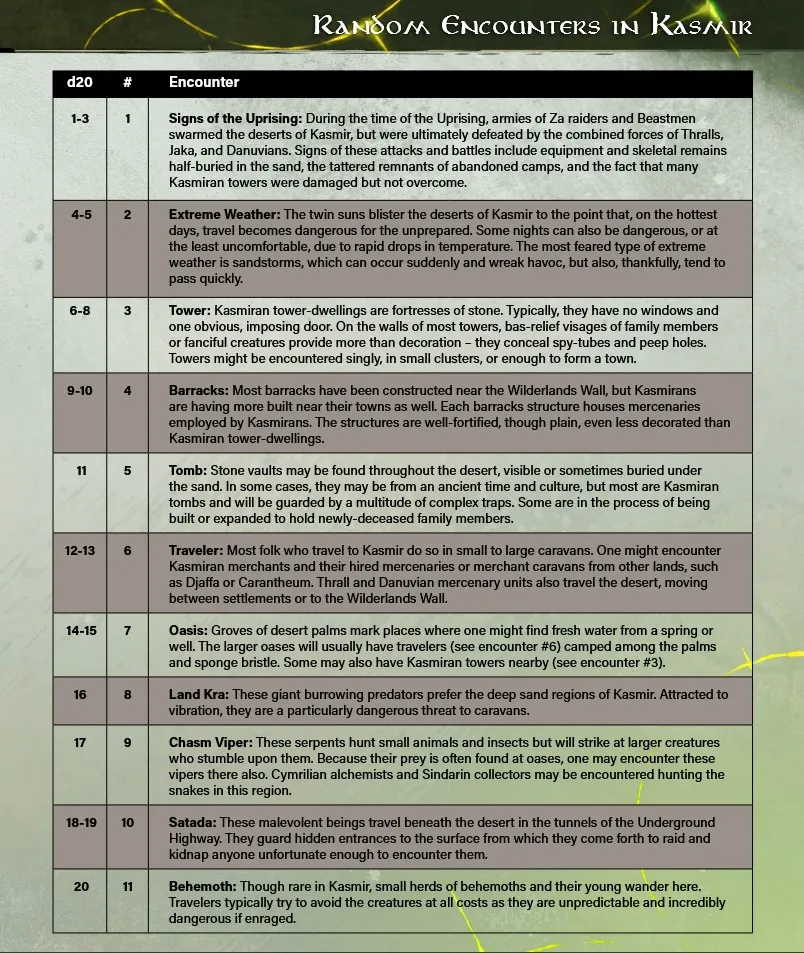
The entries are general instead of specific, listing a type of thing that could be encountered more often than just saying the thing itself. An entry for "Cottage" on the random encounters table for the Cymrilian Woods informs us that some people live in cottages, sometimes or all the time; some people who live in cottages might be friendly, or not, depending; and some cottages might be ruins, or abandoned, or have one person living there, or a whole family. This is not an especially helpful "random encounter," and I don't think that's an especially controversial claim. Give me a specific cottage, with a specific NPC living inside. Give me a specific merchant caravan, with a couple of things for sale that only they have, and a leader with a name and personality. I don't think the tables as written are wholly useless, there's some value in the fact that "cottage," for instance, shows up in the Cymrilian Woods and not in the deserts of Djaffa, but I think this kind of table is the result of a misunderstanding of the role of a random encounters table in this context. The writer is presumably worried that, if they write entries that are too specific, then the table will grow smaller (and therefore more useless) as player groups see more and more of the entries in play, so they decide to generalize the entries such that they can be used repeatedly. The result is a table full of slight nothings, that provide very little by way of interest or utility. Boring to read, unhelpful in play. And there are quite a lot of these tables! If the entries were even slightly better, the Atlas would be among the most remarkable role-playing books of all time. For a series of books like Talislanta, defined by taking huge swings, for winning big and occasionally missing big, these tables are notable for how impactful they could have been, and how mediocre they are in truth.
Overall, the sixth edition may yet be the thing that gets me to run this world at long last. It smooths over the few small pain points I had relating to its system, and presents a slightly more digestible form of the same sprawling, shallow setting I've been consistently fascinated by since I read the Chronicles of Talislanta some years ago. It's not perfect, of course. But a bit of elbow grease might get me something close. The most unfortunate part of running sixth edition is, unlike every previous edition of Talislanta, the PDFs are not available online for free. That alone might keep me in the first and second editions for the time being.
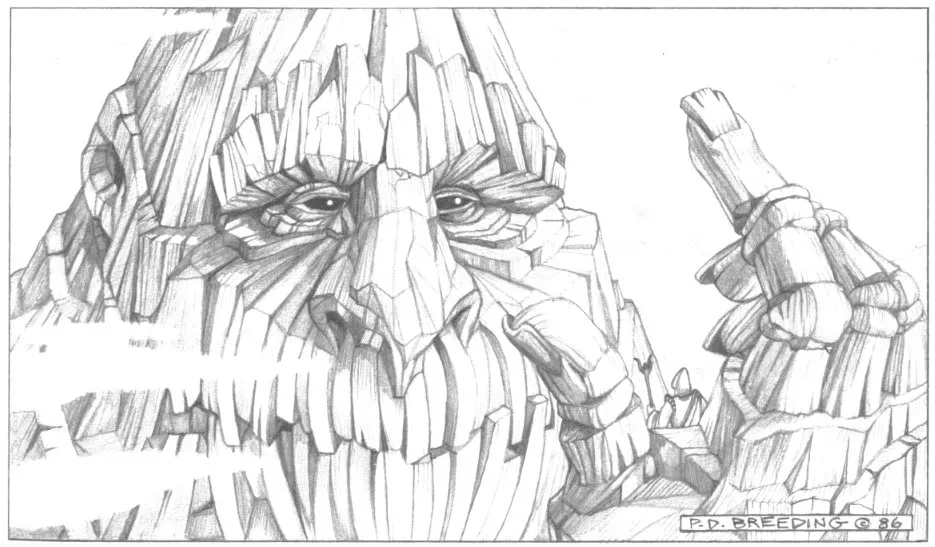
In conclusion, here's my favorite piece of Breeding-Black's line art from the early books.