Tugh Manor
The second floor here is currently unfinished. In truth, everything is currently unfinished—I'm considering reconsidering large swaths of it at all times. Maybe that's an interesting thing to see happen in real time (in slow motion, because I'm an unspeakably busy man). I've decided to publish this post before the thing is complete largely because I wanted to fill out the Potter's Bay page on this blog a little bit before adding it to the navigation bar, and I have no idea how long it will take me to get this to a serviceable state. So here it is, as it is. I'll probably move the introductory essay to the end of it once the thing is complete, but for now it's at the front.
On Haunted Houses
The wind bloweth where it listeth, and thou hearest the sound thereof, but canst not tell whence it cometh, and whither it goeth: so is every one that is born of the Spirit.
Haunted house adventures have been around perhaps as long as role-playing games have existed as a form—or at least as long as the inimitable Tegel Manor in 1977, to which this book owes no small measure of gratitude. Nonetheless, I find that most efforts in this vein miss some crucial elements that make a place feel truly haunted. Some of this can be attributed to the expedient needs of the adventure book as a form. Much of what constitutes the mood and atmosphere of a haunting must come from the referee, inescapably. The adventure book, even with its wide array of useful tools, can only do so much in this regard before becoming bogged down in non-interactive prose and such. It is a fine line, and I’ve walked it to the best of my ability here. The rest is, as ever, up to you.
On its face, the haunted house seems in some ways inappropriate for a role-playing adventure. Much of what constitutes the core of a haunting is the suddenness and arbitrariness of happenings: floors open beneath you without warning, strangling hands reach out from paintings before you can react. It’s an effective way to kill a player character, surely, but perhaps not an ideal environment for interactive play. Things seem generally to happen to characters, more than because of them. Many haunted house adventure books simply ignore this problem entirely: they assemble tropes and visuals from haunted houses, but structure them as more conventional role-playing encounters. Hostile entities engage you in battle, sinister objects give subtle hints of their danger and wait for you to unthinkingly engage them. This book does these things, too.
Nonetheless, I have attempted as much as possible to find different ways of presenting a haunting. Much of what’s here could be understood as a “trap dungeon”: rooms in Tugh Manor often contain eerie tableaux that explode (or, indeed, whimper) into dangerous consequence at a moment’s notice. Some of these things are capable of suddenly killing a player character—necessary to maintain an atmosphere of tension and fear—but many of them merely thrust an imminent danger upon them. Can you pick the locked door before the room floods with mud? Can you extract yourself from the grip of a terrible worm before it squeezes you to death? These are the techniques of capricious spirits who would like very much to see your fear for a while before they effect your inevitable, ugly death. If they can do so by preying on your limitless and foolish curiosity, all the better.
I say all of this as preface to a simple suggestion to any would-be referee of Tugh Manor: take your time. Each new room has the ability to rise, and scream, and fall. First the quiet foreboding as the characters take in their new surroundings, then the careful (though never careful enough) exploration of those surroundings; resulting inevitably in sudden and startling danger, a frantic response, and the return to quiet in the shocked aftermath.
Additionally, there is rightly no way to “clear” this haunted house, in the way one might clear a dungeon floor. Instead, one must contend with the ghosts, an enemy for which swords and polearms and magic missiles are useless. In some ways, a ghost is a perfect non-player character for role-playing games: the only way to positively interact with them is by talking. If you can get your players eager to communicate with the ghosts—and if they survive long enough to find them—you’ve got it made. From there, all outcomes are interesting, let the pieces fall where they may.
Tugh Manor
A house of “middling” size in the Georgian sensibility, Tugh Manor sits delicately in a disappearing valley just an afternoon’s walk north of Potter’s Bay. It has seen better days. Cladding hangs ominously in spots, and in spots has fallen off completely. The purple of the door has faded to a light bruise. There are no lights in the windows at night.
A visitor’s knock produces only a deep and ominous silence, until at last Gordon, Mr. Geoffrey Tugh’s long-suffering butler, jogs through the garden with greetings and farewells. The master of the house is indisposed. He leaves the way he came.
Around the corner and behind the manor, Gordon enters through the front of the manor’s garden cottage. It’s no challenge to follow him. Candlelight flickers from inside, throwing shadows across the overgrown bushes and sleeping Ipomoeas curled haphazardly around bannister and windowsill. A knock here produces the butler again, though a voice behind him shouts “Oh, do bring them in, Gordon,” before he can lodge protest.
The Garden Cottage
A tiny house meant for a gardener to live in, though the Tughs haven’t employed a gardener for some time. Mr. Tugh explains cheerfully over hors d’oeuvres that they are simply unable to make use of their beautiful home, and so they find themselves staying here for the time being. Mrs. Cranston, their cook, has a house in town. Gordon, presumably, sleeps in the pantry. The manor, you see, is very haunted.
Mrs. Geoffrey Tugh sighs without particularly noticing. Her eyes turn to glass as she faces you for the first time, ignoring her husband’s banter. “Oh, please do help us,” she sobs.
The Ghosts
“Your classic poltergeist, and several of them by all accounts,” Mr. Tugh explains, fetching a small goblet of Madeira. “Nearly burned me down last I stepped in the manor, if I’m honest. Never was one for calisthenics. Have you any experience with such things? Oh, you must think me absolutely touched. The worst part? My favorite overcoat is in there, and how it grows cold. Oh, dear!”
Though he has no idea what a group of such oddly outfitted strangers could do to change his current lot, he is more than willing to hand over the key to the house if offered even vague assurances. “Compensation will be generous, of course,” he says.
“Of course,” Mrs. Geoffrey Tugh repeats desperately. “Though do be careful with the china.”
The Manor
The front door is locked, and by a surprisingly sophisticated mechanism. Anyone who knocks just as the moon approaches its zenith finds that the door swings suddenly open before their knuckles touch the wood. A key, of course, will also do.
Ground Floor
2-in-6 chance of encounter each turn.
1-3. A creak, a whisper, a series of footsteps in the distance.
4-5. A mournful wail from upstairs, a chill breeze from nowhere.
6. 1d6 skeletons.
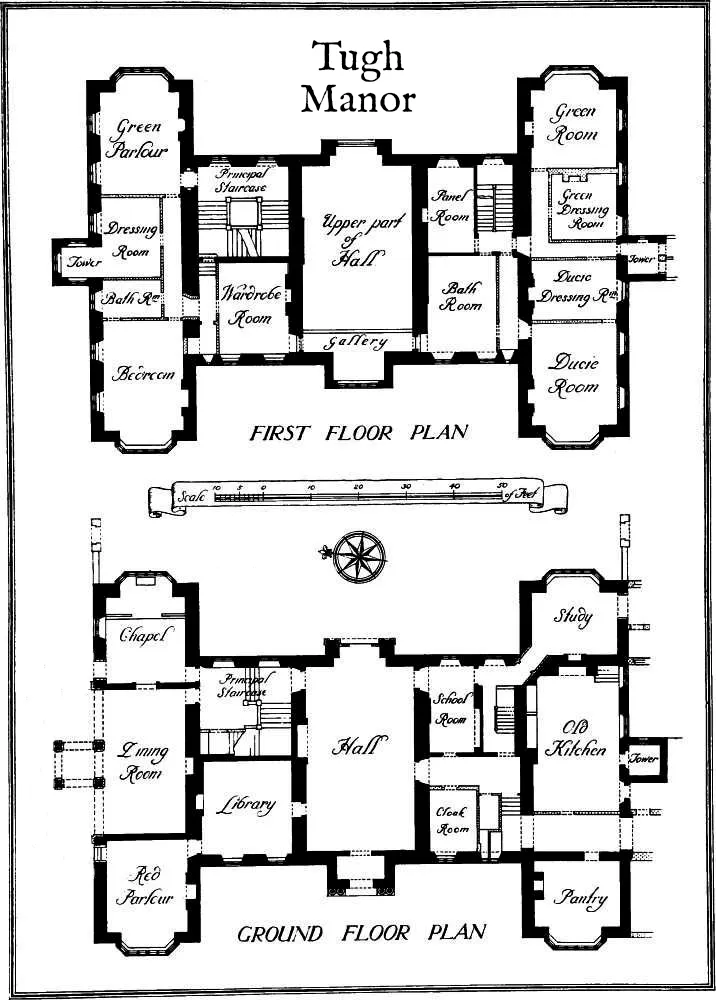
Hall
Passing over the threshold, a grandiose chandelier in gold and glass crystal high above lights itself, throwing a dim prismatic glow over the grand hall. In the far right corner, a suit of antiquated plate armor steps empty from a short plinth, and carries its lance to the center of the room to present itself for battle. The metallic grinding of its joints reverberates through the hollow armor like a stage whisper. It waits for an intruder to approach.
At the end of the first round in which one or more interlopers engage the armor in mêlée combat, the chandelier falls, crushing the armor and anyone caught underneath (2d6 damage, Save for half). The armor does not rise again.
Animated Armor. HD 4. AC as plate. Lance 1d6.
Library
Endless books, floor-to-ceiling in boxelder maple bookcases, with a rolling ladder on each wall. Upon inspection, the books appear to have no organization scheme at all (1-in-20 chance to find a book on a chosen topic each round of searching). More than half are in Latin. A pair of lecterns facing the north wall hold large and especially prized books: one labeled Vulgata Clementina, and one called Historia Familiae Tugh.
In the southeastern corner of the room, a small seating area features a couch and two armchairs of exquisite design. A Persian carpet underneath them hides a trapdoor and spiral stair into a hidden, labyrinthine library. At the bottom, low ceilings catch the dim light from torch sconces spaced just too far apart. Endless shelves of moldering books cover the walls. Each turn a person travels deeper into the labyrinth, there is a cumulative 1-in-6 chance to encounter the Minotaur. Additionally, without a way to track their path, a person attempting to get back to the exit must make a successful Save for each turn they have traveled deeper into the labyrinth—should they fail any of these Saves, they become lost forever.
Minotaur. HD 6. AC as chain. Crude oversized sword 1d6+2, and horns 1d6.
School Room
Four school desks face a wide blackboard on the southern wall in two rows. Each desk holds a bright red apple, polished to a shine. After a moment, a piece of chalk from the blackboard’s tray rises up as if by its own volition, and scrawls a message: “How do you do?”
If a person passes by the first row of desks or picks up one of the apples, a gigantic maulworm bursts forth from each apple, violently wrapping itself around the nearest warm body.
Maulworm. HD 4. AC as unarmored. Grapple 1d6.
Cloak Room
Small and filled to brimming with cloaks, overcoats, rain hats, and muddy boots. Given even a vague description of the garment, one turn spent searching turns up Mr. Geoffrey Tugh’s favorite overcoat.
When a person inside first attempts to leave this room, they find the door closed and locked. Immediately upon touching the door handle, liquid mud flows into the room as if seeping up from the floor. In three rounds, the mud covers the door. In six rounds, it reaches the ceiling. After six rounds, or if the door is opened, the mud recedes quickly. Those caught inside must Save against drowning each round for three rounds (beginning in the fourth) to attempt to keep their face above the mud (1d6 damage each time they fail).
Principal Staircase
A magnificent staircase, all in cherrywood, and with elaborately scrolled banisters along its length. To reach the first floor, one must take the stairs two at a time. Should any one person neglect to skip every other step for the entire run of the stairs, the whole flattens into a bumpy wooden slide just before they reach the top, shunting them back down to the bottom again (1 damage). When descending, the stairs always flatten at the last step, causing no damage—but it's still a bit embarrassing.
Red Parlor
Elaborately decorated in dozens of shades of red across numerous textures and patterns. Two overstuffed couches and two lean armchairs fill the center of the room. In one chair, an old woman sits with paper and scissors. She greets you warmly and offers to cut your silhouette.
Sit in the chair opposite, and she makes quick work of it: a profile in perfect likeness, black paper mounted on white. She will cut only one, citing a pain in her old hands. As she hands the silhouette to her subject, she disappears like a fog dispersing in wind.
Any other person holding this silhouette in both hands can close their eyes to see as if through its subject’s eyes. They can concentrate to hear what the subject hears. Damage done to the silhouette damages the subject also. If it is destroyed, so too are they.
Dining Room
A long table to seat ten, with brocade runner and five bespoke candelabras. A sideboard along the southern wall serves as a makeshift butler’s pantry, as well as a service area as required. Large windows along the western wall open onto a view of the gardens that would once have been stunning.
A group of skeletons occupy this room, a grotesque caricature of the Tughs and their servants: Mr. and Mrs. Skeleton sit in front of settings at opposite ends of the table, two tuxedoed skeleton footmen wait to serve from the sideboard. As you enter, the candelabras light suddenly, and Mr. Skeleton stands to greet you. He bids you sit, “Of course you’ve travelled far, no need to dress for supper this night. Let us be as family!” The footmen silently place settings in front of you.
After a short toast and announcement from Mr. Skeleton, food and wine emerge from plate and glass like plants growing in time-lapse. First a course of four soups (roasted chestnut, China squashes, mock turtle, garden pea), then a course of three fishes (Northern cod with cherry pickle and chèvre, haddock on plank with fermented barley and beurre blanc, scallop cakes over mashed turnip and Montgomery cheddar), then five roasts (calf’s tongue with bitter herbs, candied venison, a waterfowl medley, hare in brown butter, turkey and asparagus pie), and seven desserts (pears pie, blackberry slump, a selection of gingerbreads, boiled pudding of spiced Eastern plums, iced cream with honey and fresh blueberries, apple tansey, lemon curd and raspberry fool). Each course comes with two wine pairings. As one course ends, the footmen remove the plates and glasses and new ones appear with the next course’s meal. The Skeletons shovel food and drink down themselves endlessly, and seem unfazed as it falls between their jawbones and over their clothing and table setting. They occasionally decry their abiding hunger, and primly praise the Lord In Heaven for such bounty.
Supper continues in this fashion, circling around from soups to fishes to roasts to desserts over and over for as long as the visitors are willing to sit and at least pretend to eat. There are no encounter rolls for the duration. A person who stops eating, or who makes to stand, finds themselves chastised, then stopped by the skeleton footmen. Pushing the issue escalates things quickly: the skeletons exact violence if necessary to protect the integrity of their supper.
Skeleton Footman. HD 2. AC as unarmored with shield. Carving knife 1d6+2. Silvered serving tray as shield. Once both butlers are defeated, Mr. and Mrs. Skeleton disintegrate.
Chapel
Solemn and silent, walls clad in imported French stone. The altar contains a relic of St. Drogo, the crucifix was the deathbed work of an unnamed German abbott and sculptor. An oversized tabernacle of gold filigree sits on the eastern wall behind the altar rails, though it has not held the host for many decades. A cathedral rector could be extorted for large sums of silver in an effort to rescue these objects from thieves’ hands, though he may also report it to the relevant authorities.
Anyone who prays fervently here gains a blessing (for each attribute check or attack roll they fail, they have a 1-in-6 chance to succeed instead, until they have so succeeded one time).
Study
Various mounted animal heads line forest green walls, with brass candle sconces interspersed. A huge desk of Indonesian mahogany displays dozens of drawers on every side, a desk-lamp of green glass and brass, and a pristine leather writing pad. Two small bookshelves hold various volumes of epic poetry and theological treatises. A large portrait of Mr. Tugh with hunting dogs hangs on the eastern wall.
The mounted bull’s head on the western wall carefully observes anyone who enters, moving only its eyes. If they approach too close to the portrait, it lunges at them, its neck stretching to close the space, and gores them with its horns.
Mounted Bull’s Head. HD 4. AC as leather. Horns 2d6. Hits automatically on surprise.
Kitchen
A working kitchen, clean as a whistle and ready for service. Copper pots and pans shine on their racks, utensils stand proud in their specific basins. Black and white tiles, twelve inches on a side, checkerboard the floor—the black tiles are actually pitch-dark holes. Anyone traversing this floor normally must Save or stick their entire leg into one of the holes, where it’s bitten completely off by some unseen creature. No amount of light shed into the holes reveals any visible thing.
Pantry
An oversize pantry, with unfinished wooden shelves and paltry stock. Dust and cobwebs cover much of what canned goods are left.
Tower
A wrought-iron spiral staircase extends upward to the South Tower on the first floor.
First Floor
3-in-6 chance of encounter each turn.
1-2. A creak, a whisper, a series of footsteps in the distance.
3-4. 2d6 zombies.
5-6. 2d6 skeletons.
Principal Staircase
As on the Ground Floor.
Wardrobe Room
A sizable wardrobe, its walls covered with the Tugh’s clothes on racks and in dressers. The wallpaper—an elaborate geometric pattern in gold on navy blue—is dry and crackling to the touch, and has started to peel in several places. A heavy chest of drawers in the center of the room comes to waist height, a working surface for servants to mend and arrange clothing as necessary. Its drawers are full of sewing notions, scraps, and other necessaries. An oversize glass chandelier glistens against any light in the room; its six arms hold six snuffed candles.
Anyone trying on the clothes here finds themselves bound in the fabric. Sleeves and trouser legs extend and wrap their wearer increasingly tightly (Save or be immobilized, 1d6 damage each round while bound). It takes 1d6 rounds to cut a victim out of a garment, or 1d4 rounds if done hastily, though the victim takes 1d6 additional damage in the process.
Gallery
A walkway that overlooks the hall below, with a large plate-glass window that lets in the summer sun. A small seating area in front of the window consists of two padded scrollback chairs, a small mahogany side table, and a large fern.
After a few minutes of exploration here, the fern bursts into flame without burning (anyone sitting in the chairs takes 1d6 damage from the flame), and casts a bright light across the gallery and hall. A deafening voice rings out from the conflagration, “Stay thee away! Remove not thy shoes, for this is a place of dishonor. We have seen the disgraceful acts of man, and so we shall provide him with a suffering long deserved!” After this, the fire dissipates. Roll two encounters (+2 to each roll).
Bath Room
A large footed tub, surrounded by small blue-and-white tiles. Modest shelving contains exotic sponges, soaps, lotions, and salves. A full length mirror adorns the western wall.
The floor here is slicker than the slickest ice (Save each round or fall prone, then Save the next round to stand again).
Panel Room
A small room with shiplap walls above whitewashed wainscoting, built to display various curios and bric-à-brac, though now used for unorganized storage.
Among the variety of mouldering boxes, three remarkable items:
- An antique flintlock pistol, engraved with elaborate acanthus designs (3d6 damage, ignores armor, 1d6 rounds to reload).
- A lightly faded watercolor by legendary local artist Gil Pesterson, depicting a highly romanticized scene of an Imperial frigate mid-broadside against a pirate ship.
- A child’s stick horse, at least 100 years old, with batting escaping from its missing left eye. Inside the stuffed head, a tightly rolled paper shows a map to a “Secret Treasure” somewhere deep in the woods west of Potter’s Bay.
Green Room
Garish lime green paper covers the walls, and dark green carpets cover the floor. Two separate seating areas occupy the north and south areas of the room, and on the east side, a writing desk and chair in dark wood. After one turn spent in this room, the carpets sprout into a beautiful grass lawn. The following turn, the grass grows tall and thick, making traversal difficult (three turns to push through it from one side of the room to the other, or two turns if hacking at it with a blade weapon).
Green Dressing Room
Styled in the same lime green of the Green Room, and filled to brimming with gowns and stoles and shoes and undergarments sufficient for years of unrepeated outfits. An oaken chiffonier contains a modest collection of chains and jewels. A dozen different ladies’ wigs adorn the south wall, each one more grandiloquent than the last.
A low, padded stool sits opposite a table mirror to one side of the room. Anyone sitting on the stool who looks into the mirror sees into the saloon on the second floor: a turn spent observing in this way shows the viewer a number of phantasms, all of whom bear some familial resemblance to Mr. Tugh. They float back and forth, their expressions passing from rage to devious intent at a moment’s notice.
Ducie Room
A garishly decorated room, with colorful floral patterns on the walls and ceiling. A rattan bedspread adorns a bed dressed in dark magentas and violets, and potted ferns line all four corners. Under the bed, 2d6 cramped kobolds unsuccessfully attempt to keep quiet, for fear of being attacked by the skeletons and zombies that roam the house. They will be grateful for assistance in getting to safety, but cannot keep themselves from attacking humans for very long. They know the layout of the ground and first floors very well, and are adept at moving through the space quietly (-1 to all encounter rolls while with the kobolds).
Various tropical birds, taxidermied, hang from the ceiling and perch on the dresser and bedposts and fireplace. Each turn, one of the birds screeches without moving (roll one additional encounter every turn).
Kobold. HD 1. AC as unarmored. Weapon or bite 1d6.
Ducie Dressing Room
Decorated in similar colors to the Ducie Room, but without plants or birds. Extensive cabinetry and racks hold a respectable man’s wardrobe and sundries, a standing mirror on the south wall. The window here stands open with a strong breeze flowing out through it, dragging the drapes with it. Anyone getting too close must Save or fly out over the sill, landing in the east garden (2d6 damage).
Bedroom and Bath Room
Both doors into this room are securely locked, as well as the hallway bath room door. It is decorated precisely à la mode moderne: sparsely furnished with aquiline carved wooden furniture, smooth wooden floors, curvilinear cabinetry, and delicate floral upholstery, all in shades of burgundy and with silver adornments. There are no encounters in this room or its adjoining bathroom.
Dressing Room
A plain and unassuming room, nearly bare. A crudely carved hope chest against the north wall, and two unpadded wooden chairs against the south wall. A side table between the chairs holds an old clock, still keeping accurate time. In the middle of the room, one spare rack of modest women’s clothing in brown and undyed cloth.
In the hope chest, a red sequined dress lays folded among a quilt and set of towels. Anyone inspecting the dress closely notices that the sequins are thousands of miniscule rubies.
Green Parlor
A massive canopy bed, surrounded by green walls and ivory wainscoting, nestles in the floor-to-ceiling bay window on the north wall. A dressing cabinet and vanity take up the southeastern corner. At the foot of the bed, a covered bassinet coos and rustles gently. One who uncovers the bassinet finds it empty, except for a pair of infant’s stockings each containing one silver dime.
North Tower
A wrought-iron spiral staircase extends upward to the second floor.
South Tower
A wrought-iron spiral staircase extends downward to the ground floor.
Second Floor
3-in-6 chance of encounter each turn.
1-2. A moan, a chill breeze, a series of footsteps in the distance.
3-4. A cloud of ghosts passes through you and disappears.
5-6. 1d4 wraiths.
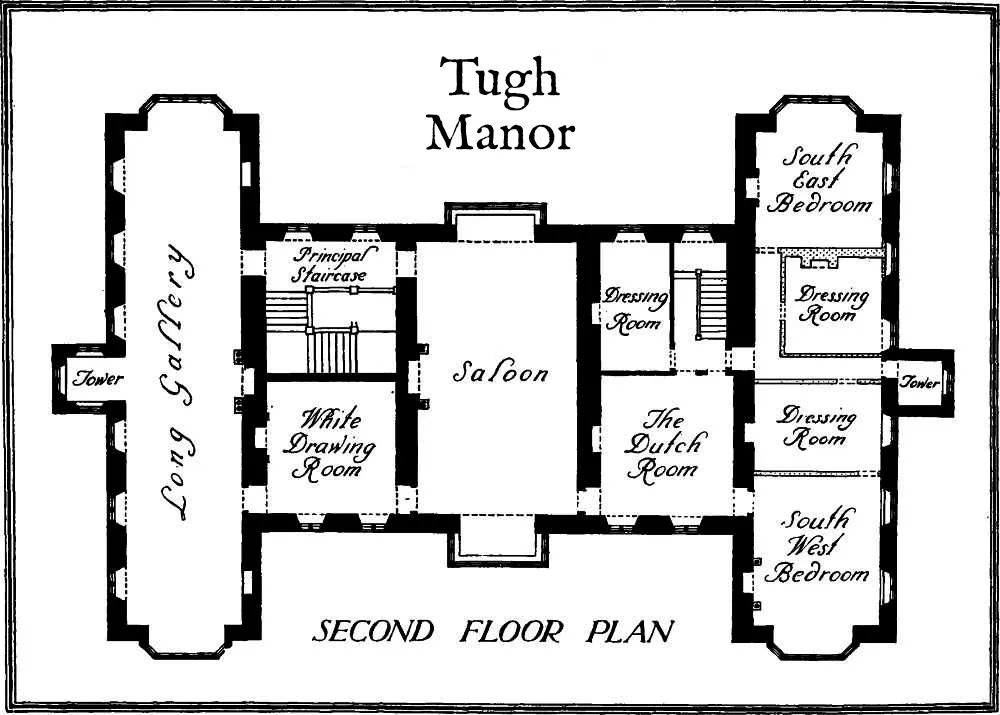
North Tower
A wrought-iron spiral staircase extends downward to the first floor.
South Tower
A small alcove, containing a padded close stool and a water basin. The close stool is half-full, and contains 1 gold piece glinting out from the miasma.
Long Gallery
Principal Staircase
As on the ground floor.